
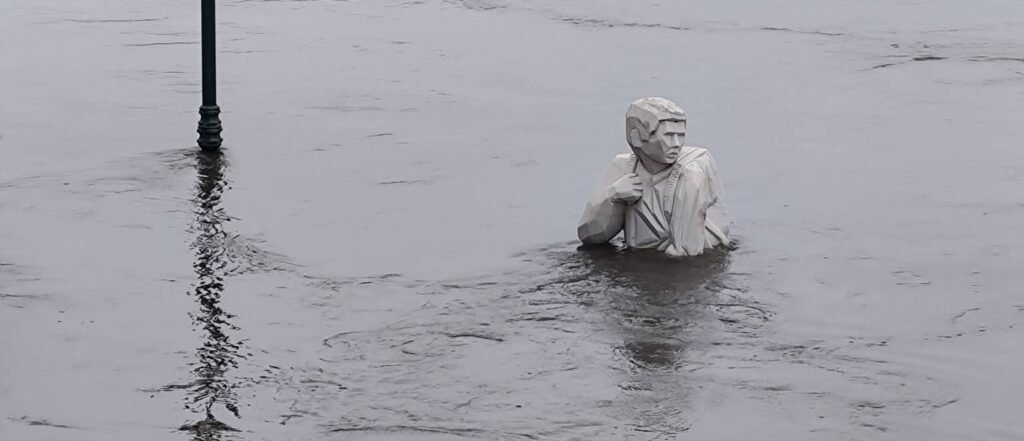
Extreme flooding in the Rio Guadiana in January and February 2026 turned this usually tranquil river into a torrent of danger and loss.
Many people sail their boats to the Rio Guadiana for the peace and nature. Its generally benign conditions lead to people considering it to be a safe and cheap place to keep their boat.
But what happens when your corner of paradise grows teeth and turns against you?
The Rain in Spain and Portugal
In January and February 2026, a succession of storms marched in from the Atlantic – Marta, Kristin and Leonardo – bringing rain and wind across large parts of the Iberian Peninsula. They dumped vast amounts of water on already saturated land, aided by an atmospheric river flowing from the Caribbean. Many areas of both Spain and Portugal were flooded, taking lives. Violent winds also did their worst along the Atlantic coast.
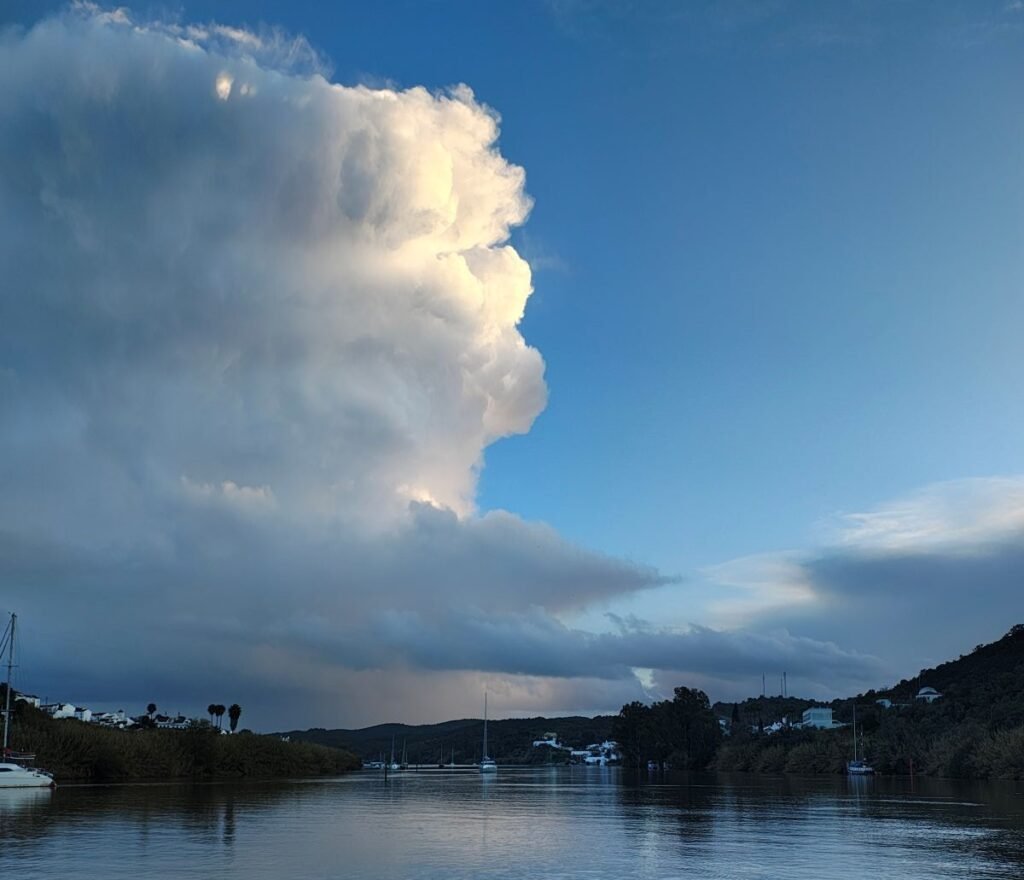
The Rio Guadiana
The Rio Guadiana rises towards the east of Spain in Castilla-La Mancha. It then meanders 515 miles/829km across Spain towards Portugal where it forms part of the south east border. Its exit is between Ayamonte and Vila Real de San Antonio, with a tidal section stretching inland as far as Mertola.
The river has a vast catchment area. So even if rain wasn’t falling directly into it, it was a certainty that rain falling elsewhere would eventually run into it.
Along the way there are 30 reservoirs, some used for water storage and others for generating hydroelectric energy. The Alqueva Dam is one of these, and it’s the largest reservoir in western Europe.
Our location was downstream of this dam on the tidal part of the river. Close by were the villages of Alcoutim in Portugal, and Sanlucar in Spain.
People leave their boats on moorings, tied to the pontoons, rafted to shore or kept at anchor. Usually with someone keeping an eye on them when the owner goes away. Then there are those boats that are seemingly abandoned at anchor. They then drag around and hit other boats with no one knowing who the owners are.
The Alqueva Dam
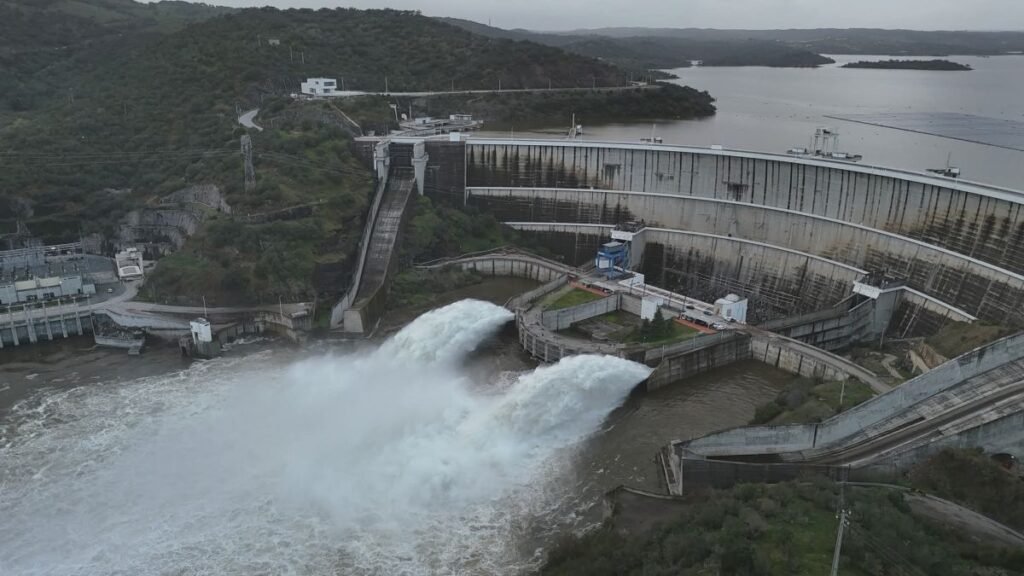
The Alqueva dam generates hydroelectric energy, via water falling through turbines into another dam below. Obviously, these dams have a finite volume. So, to prevent a dangerous overflow, they have gates that can regulate the release of water.
On Wednesday the 28th January, the dam’s flood gates opened for the first time in 24 years. The release rate was 1500m³/s.
The released water takes over 18 hours to reach Mertola, ten miles north of our location. So, by Thursday morning, we began to see an increased flow and the level rising higher than the highest spring tides.
Two days later, the gates were closed. By Saturday morning the river level had eased considerably. However, closing the gates seemed odd given the weather forecast was predicting much more rain to come. Despite that niggle, we relished being able to get ashore given that we’d been been stuck aboard for a few days.
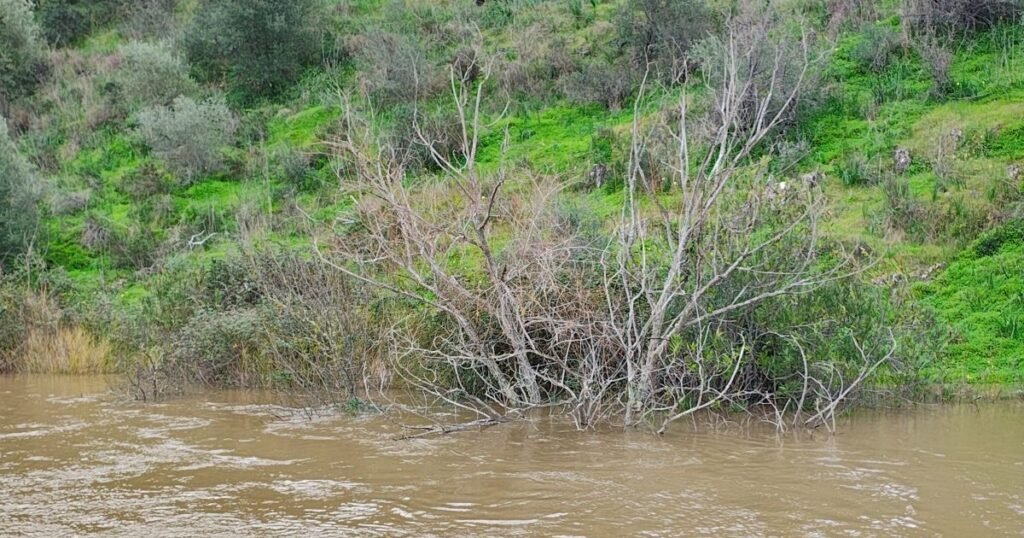
A Mind Boggling Amount of Water
But why did they close the gates? To have kept releasing at a lower level to prepare space for the rain to come seemed like a sensible thing to do, to us, the lay people. But, with the gates closed, the water level continued to rise as rain water flowed in. I guess they had their reasons.
Initially, the dam management company had posted information on their Facebook page. However, the continuing flow of information became inversely proportional to the flow of water. Instead of data, they posted videos of the water release, describing it as a stunning sight. Perhaps if we hadn’t been caught up in the chaos that was unfolding downstream, we could have admired the engineering of the dam.
Inevitably, they reopened the gates, with significantly greater releases than before. 1500m³/s became 2500m³/s, which increased again to 5000m³/s. That’s 5,000,000 litres per second, for those who prefer metric. A vast, mind boggling amount of water was now funnelling down the river.
Monday – The Calm Before the Storm
On Monday I drove to Tavira to sort out a problem with our internet, and decided to do a big shop. It turned out to be a wise decision.
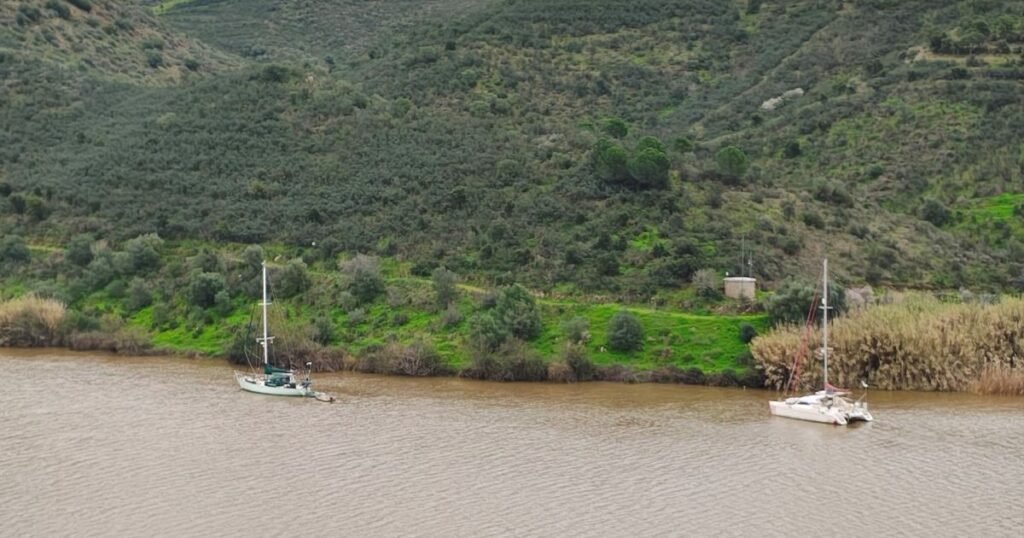
When I got back, with the likelihood that more water was coming, we decided to leave the mooring that we’d been using. We didn’t go far, moving to anchor on the opposite side of the river as it was out of the main flow and the holding was good. We have a lot of trust in the holding power of our 33kg Rocna anchor, and 70m of 10mm chain provided plenty of scope to let out more as the river rose.
The managers of the Sanlucar pontoon cleared all boats off of the pontoon the same day.
Why didn’t we head south at that point? Some friends headed south to where the river widened, and the flow reduced. Others like us, stayed up river.
Really, we had no inkling that the situation would get as bad as it did. Last March we’d sat out a few days of higher river levels when a different upstream dam had released water during a rainy spell. The river and current rose a little, but that was the worst of it. That was our only experience of flooding in the Guadiana, so with that in mind, our hope was that things wouldn’t get worse than they currently were.
Tuesday – a Foretelling of Worse to Come
Our first fright came on Tuesday, when a single hander tried to anchor close in to the bank upstream of us. His anchor didn’t hold and he drifted very quickly down stream while he lifted it. With the anchor up, he was still drifting sideways towards Emerald, taking his sweet time coming back from his bow to the cockpit. It took repeated shouts from us to get him to take notice of how quickly he was drifting. A near miss caused by another boat left us feeling jittery.
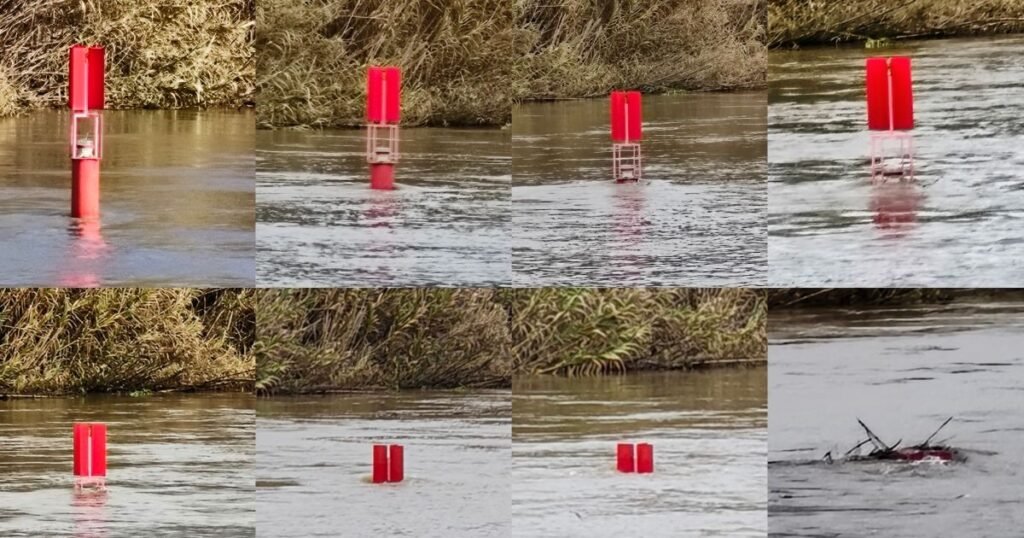
Last week, the water level had risen to just below the light housing on the navigation poles, before retreating. Throughout Tuesday, the water crept up over the light housing and on up towards the light cap. As night fell, the flashing red cast an eerie light on the water lapping around it.
Surprisingly we slept well that night, with our GPS anchor alarm on its lowest setting – 0.01nm (18m) – to alert us to any movement. It turned out to be our last good sleep for several days.
Wednesday – Everything Kicks Off
On Wednesday morning we woke to see the very top of the navigation pole disappearing underwater. Now, just a patch of turbulent water and twigs marked its location.
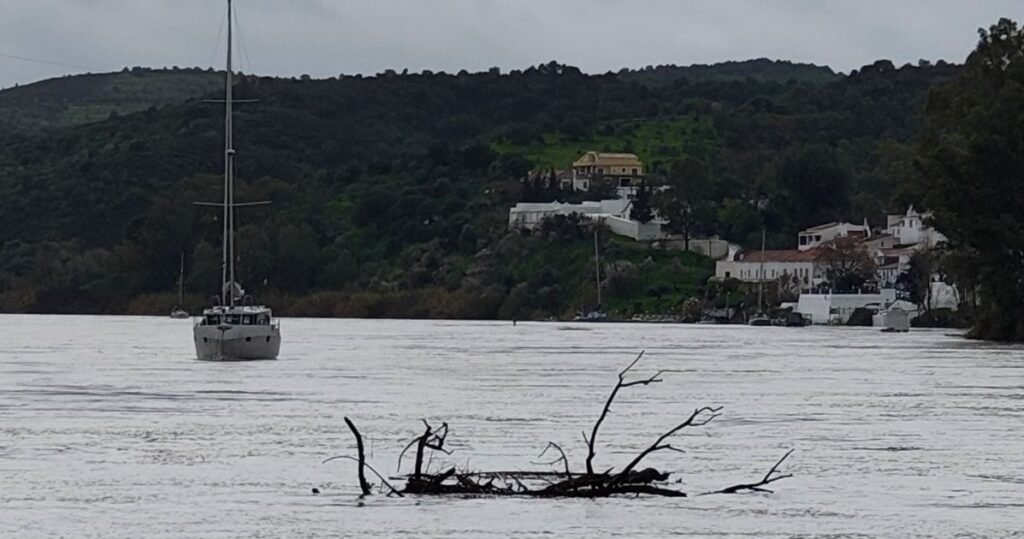
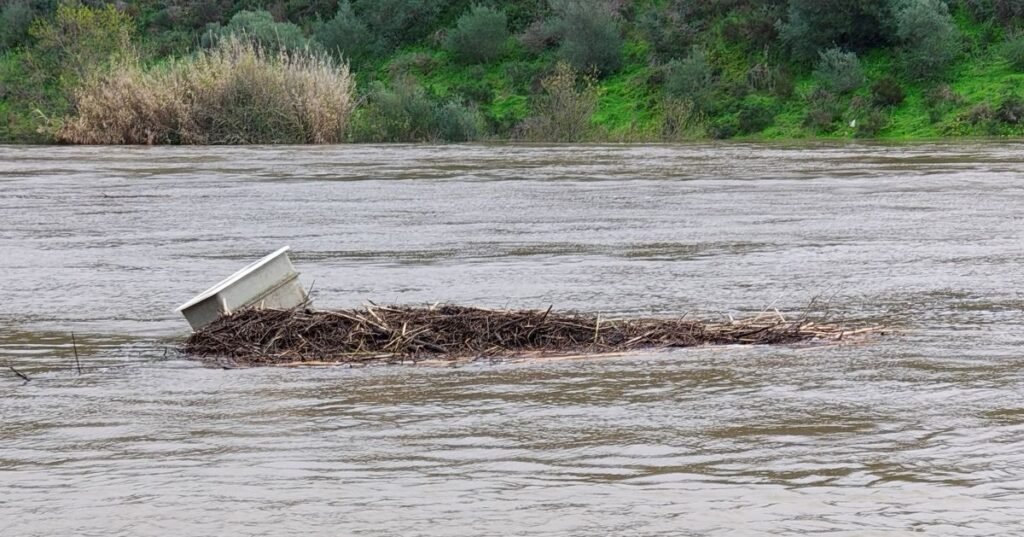
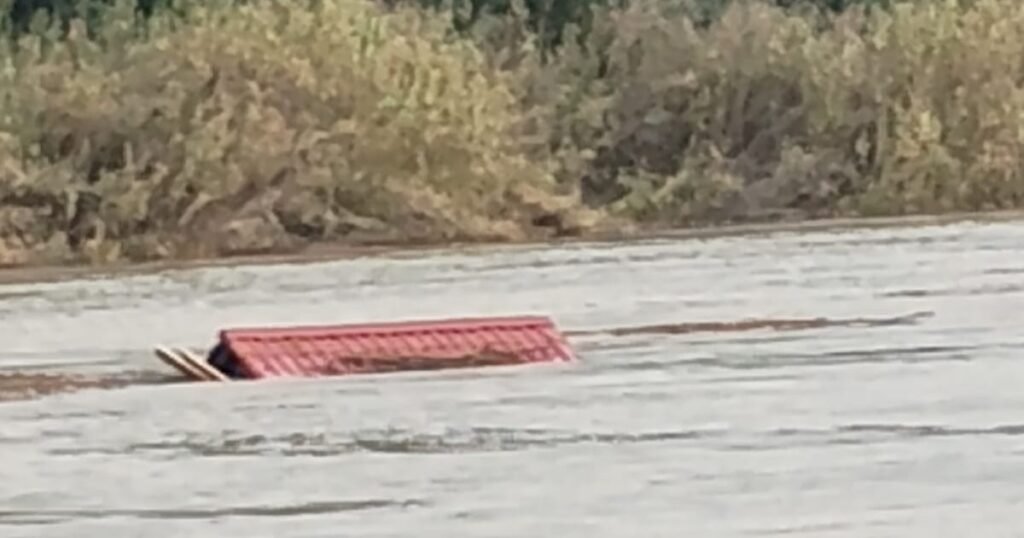
Whole trees were now floating down the river, their roots washed out from the river banks by the height and speed of the flow. And not just small, spindly trees, but huge, decades old, trees. Fridges and freezers, bits of broken pontoon, anything that was once many meters from the river bank, was now caught in the river’s grip. Even a shed passed by, its pitched roof sticking jauntily out of the water.
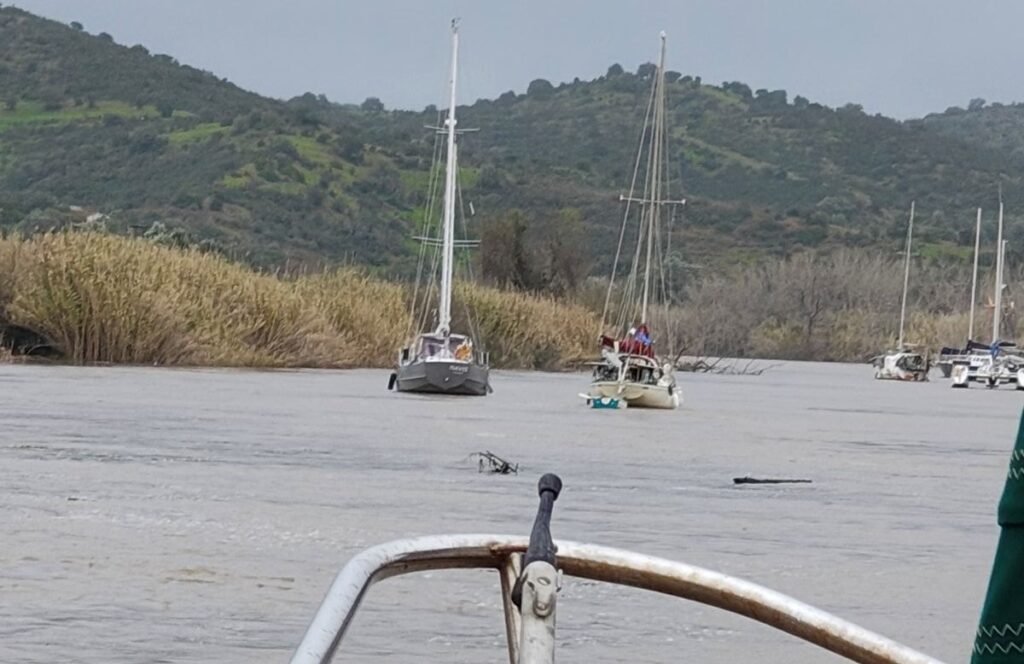
Unattended boats began to be a concern. With no one onboard, there was no one to let out more chain, or extend a mooring riser. Three boats upstream of us were visibly on the point of popping their moorings, their bows pulled down as the mooring risers were stretched to their limit. It was a question of ‘when’ rather than ‘if’ as to whether one of them floated free and drifted down to our position. Drift sounds too gentle a word. With the current running at at least 4 knots, a boat could be free and hitting us in no time. We had 50m of chain out, which would take several minutes to lift. Time that we wouldn’t have if another boat was lying on us, adding to the force of the current that was already stretching Emerald’s anchor chain bar taut.
The First Dragging Boat
Inevitably, one of the three unattended boats, started drifting backwards. What to do? Thankfully, it was dragging its mooring along, which slowed it down, giving us a chance to think.
We could adjust our helm to put Emerald further out into the river and hope that the boat passed between us and the bank. But we couldn’t shift where our anchor was lying in the river bed, and it was in the path of the drifting boat.
If the mooring snagged out anchor, trying to get ourselves free from the weight of the other boat lying on Emerald in the strong current would be incredibly difficult. We’d likely have to dump all our chain and cut the bitter end. That would leave us relying on our back up anchor, a 30kg Bruce. An OK anchor, but we wouldn’t want to rely on it in those conditions.
I admit, for a few seconds we froze like rabbits in headlights watching the drifting boat hit another boat ahead of us. But somehow, the second boat held and the first boat continued on alone towards us. It then snagged on something else, and stopped. The opportunity for us to take action was right now as who knows how long it might hold for.
It Was Time to Leave
Engine on, windlass on. With the engine working hard to motor us forward and relieve the pressure on the anchor chain, the windlass was able to reel the 50m of chain in. This was the first time we’d used the windlass in anger since repairing it in January.
With our eyes glued on the dragging boat, willing it to stay put, each meter of chain pulled in seemed to take forever. Colin called out 20m. Then 15. At 10m the anchor would be free of the bottom and we’d be able to motor away.
10m came the call. The dragging boat was still holding, so we held our nerve and fully retrieved the anchor before moving away. There was so much debris in the river, that if we turned out into the middle of it, there was a risk of the anchor snagging on something whilst it dangled on its way up.
With the anchor safely weighed, we could move away. But where to? Briefly, we considered heading north around the corner. Then we remembered that there were unattended boats there too. Also, the engine was already running above our usual operating revs, and we were only making 0.5kts headway.
For those familiar with our engine woes of 3 years ago, you’ll remember that we rebuilt it ourselves. We’re still paranoid that it will fail again and we haven’t pushed it hard for that reason. And now definitely wasn’t the time for experimenting.
So, I turned the helm, the current picked Emerald up and we were soon flying south. We wished our friends good luck as we sped past at 10kts SOG.
A Stressful Game of Frogger
Despite easing back on the engine, we were still travelling fast, and overtaking the debris. Bursts of engine revs gave us steerage, and helped us to manoeuvre around it. It might have been fun, this live action game of frogger, except any contact could be really game over.
On the plus side, an advantage of the quick flow was that much of the flotsam stayed in a defined track drawn by the fastest current. This left us with a small, relatively clear path for avoiding it. Relatively, because there was still plenty of detritus strewn right across the whole river. It was just that the largest bits were staying in the fastest flow.
In addition, rather than being an aid to navigation, the green and red navigation poles had become a danger. Many of the poles were now fully submerged, their position marked only by bubbling water. But by keeping a keen eye out and monitoring our position on the Navionics chart, we were able to avoid them.
The S Bend of Larenjeiras
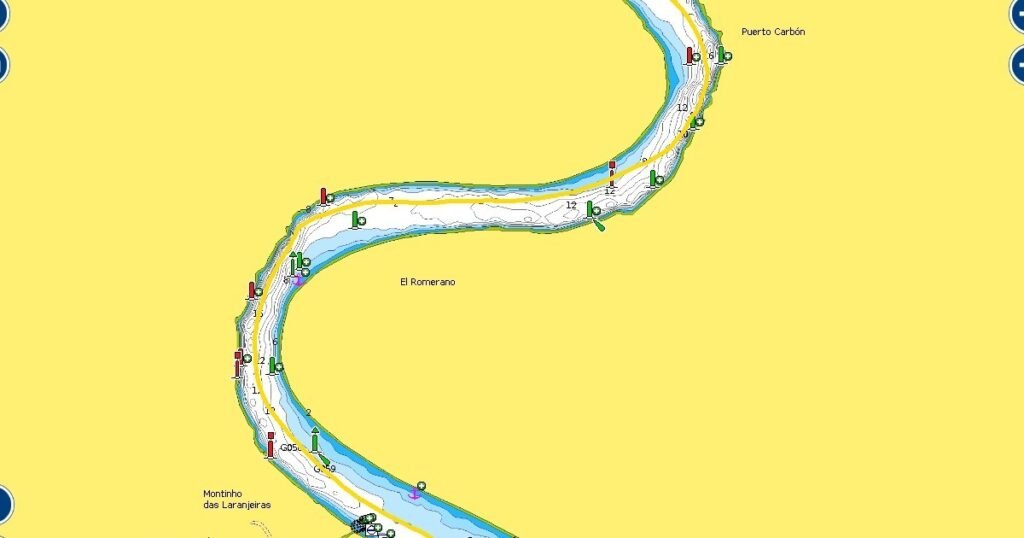
Our biggest navigation challenge was the S bend just north of Larenjeiras. Here we had no choice but to be in the main flow as the river narrowed. The current was slightly slower on the east side, but moored boats meant that we couldn’t take that path.
It was here that we caught up with the shed that had floated past earlier. With baited breath we successfully slalomed around it.
However, as we came out of the bend, the current was trying to sweep us south. Right towards the top of a green navigation pole just poking up. Gunning the engine pushed us forward enough to just clear it, all whilst also trying to avoid a floating forest.
A Slightly Easier Path
From here on, the passage became slightly easier. For one, the tops of the poles were now visible. But we didn’t bother navigating around them. Given the rise in the river level there was little risk of going aground. So, we reckoned the safer route was to avoid being swept into the poles.
The river also began to widen, reducing the flow. Emerald’s speed reduced to a relatively comfortable 8kts.
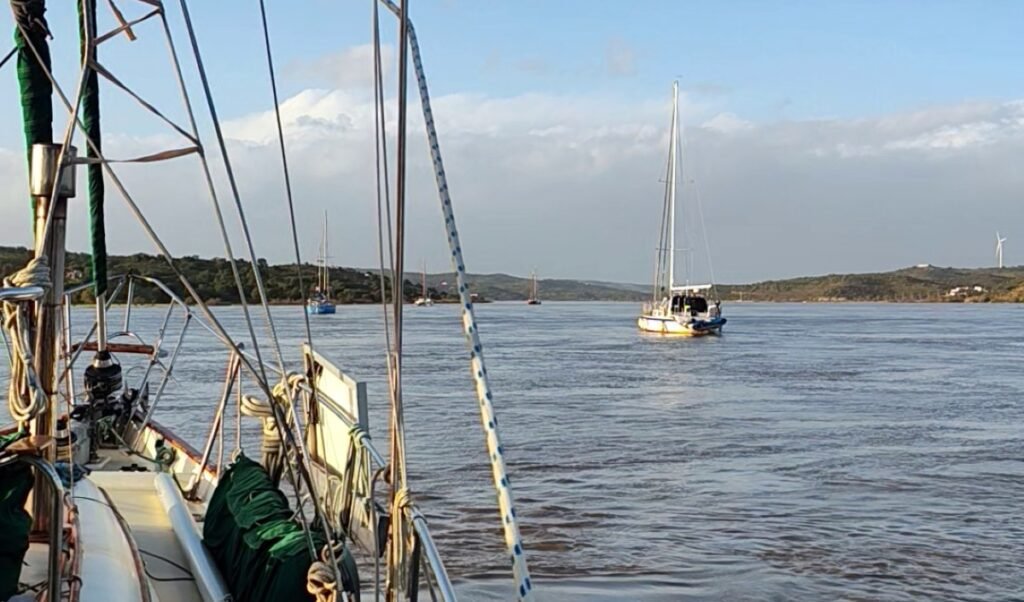
90 minutes after lifting the anchor, our destination appeared around a bend. The sight of our friends anchored there was like balm for our shredded nerves.
We dropped anchor behind them and the current quickly pulled us back. A sharp jerk told us the anchor was firmly held. We could let out the breath that we’d been holding for the last few hours.
We Left at the Right Time
With the boat and ourselves relatively safe, we now had time to check the messages that we’d been sent, and catch up on the river WhatsApp group. Minutes after we’d left, a yacht moored against the bank just upstream of us, capsized into the river. The dragging boat did start moving again, fully justifying our flight.
Later that afternoon, the other two of the three boats that had been moored ahead of us, also dragged. And not just them. The water continued to rise, and more boats from upstream became loose. Even those with plenty of chain out came unstuck as whole trees caught on anchor chains, and anchors failed under the excess pressure.
We’d got away just in time.
Not that it was all plain sailing from here on. All that debris and all those boats were now heading downstream towards us.
The Aftermath of the Extreme Flooding in the Rio Guadiana
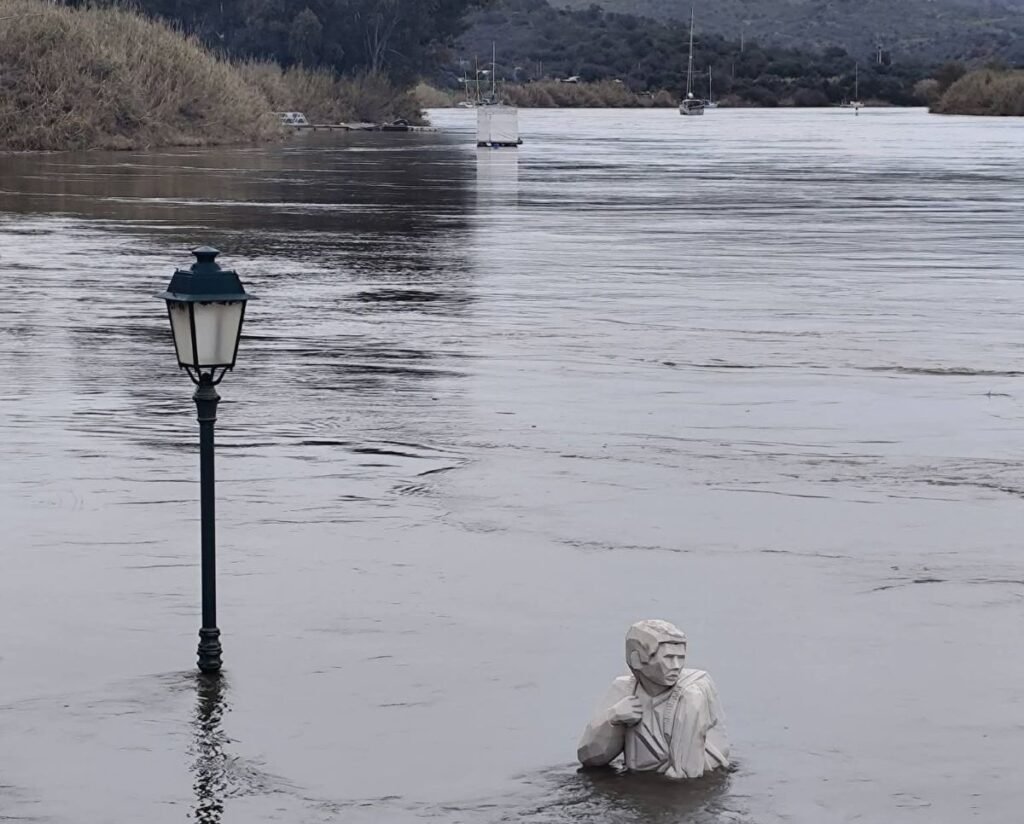
During the course of the flooding, the Rio Guadiana rose 6m above normal. The villages of Alcoutim, Sanlucar, Larenjeiras and Guerreiros de Rio were inundated. Homes and businesses were severely damaged and the pontoons that had been a safe harbour, were now at risk of breaking their piles and chains. Boats sank, washed out to sea or ended up high and dry on the river bank.
And worst of all, the river tragically took a life.
The next blog will cover the two weeks after our escape, as our nerves and endurance were tested in ways we could never have imagined.
The Social Media Bit: Want to Follow Us?
Thank you for reading this far, we really appreciate it. If you’ve enjoyed our site or found it useful, please consider a donation via the DONATE button below. We’re grateful for anything you can spare!
If you’d like to follow us on other social media platforms (Facebook, Instagram and YouTube), you can do so by using these links:
Or use the link below to track our voyage on NoForeignLand.com.

And finally, you can sign up to receive email notifications of new blogs using the subscribe box at the bottom of this page.
Thank you from Nichola & Colin